
The CBDA certification (Certification in Business Data Analytics) is an IIBA exam for business analysts who work with data. It checks whether you can frame the right question, get usable data, read the results and turn them into a business decision. It does not check whether you can write SQL or build a model. As of October 2026, it is 75 scenario-based questions in 2 hours, taken online, with no experience requirement [1][2].
I passed it in December 2025 (my IIBA badge). Below is my result by domain, what helped me, what tripped me up, and an honest view on who should take it.
My result by domain
IIBA does not show a score. The pass email gives each domain a label: lower, comparable or higher than the minimum score of passing candidates. Here is mine.
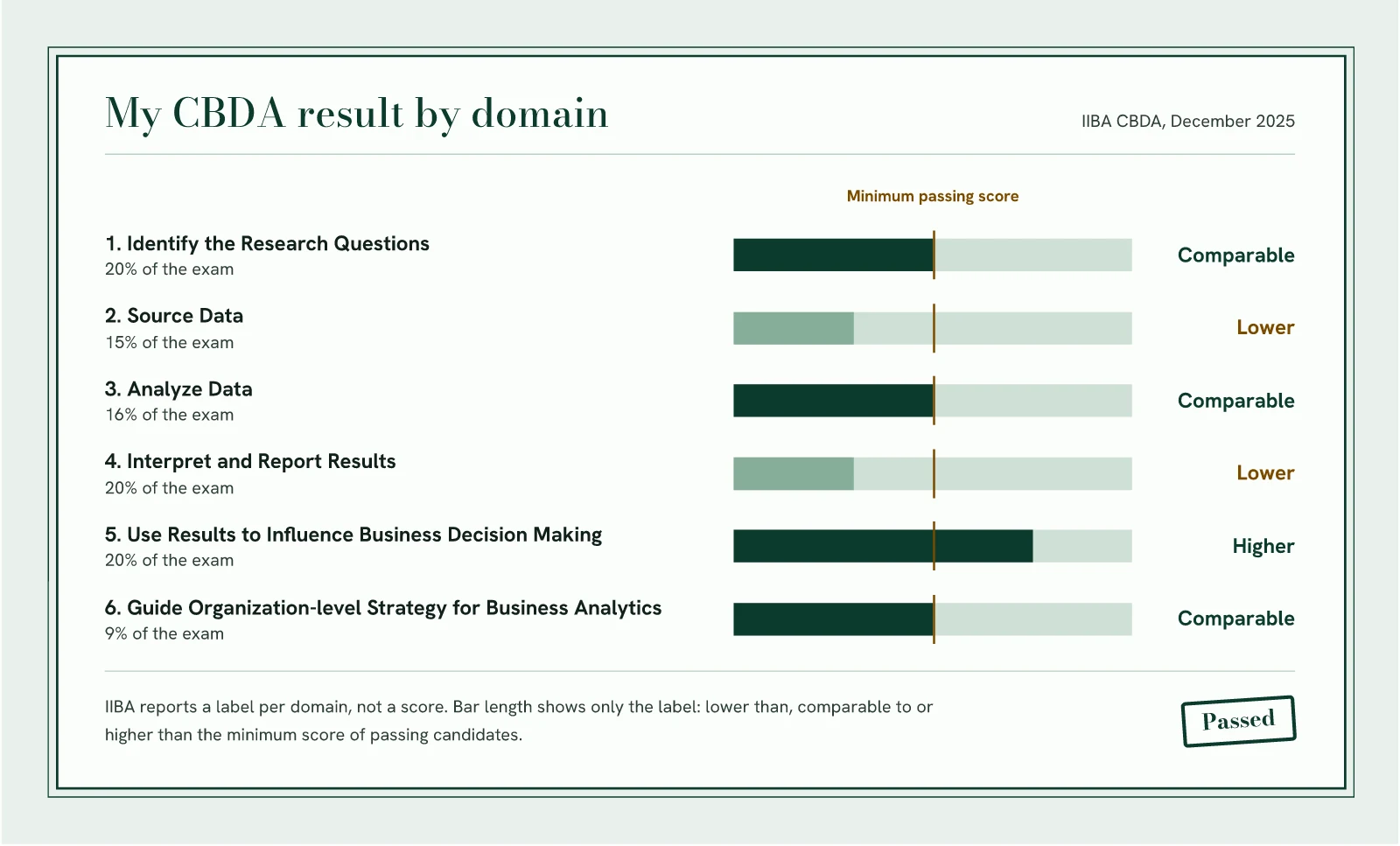
What I read from it:
- Strongest: decision making (domain 5). This is where my work experience helped most. I spent years next to people who make decisions from numbers.
- Weakest: Source Data and Interpret and Report Results (domains 2 and 4). Both are full of small details: types of data sources, chart types, kinds of analytics. They are easy to mix up.
- The rest: comparable. So I passed with a margin in one domain and below the line in two. Domains 2 and 4 together are 35% of the exam [1]. That is the part I would study harder next time.
CBDA certification in numbers
| Item | Value (as of October 2026) |
|---|---|
| Questions | 75, multiple choice, scenario-based [1] |
| Time | 2 hours [1] |
| Delivery | Online, remote proctoring through PSI; no test centres for CBDA [2][6] |
| Eligibility | No work experience required; IIBA recommends 2 years in business data analytics [2] |
| Fee | $250 for IIBA members; $405 for non-members, including one year of membership [3] |
| Rewrite | $195 members / $350 non-members [3] |
| Passing score | Not published by IIBA [1][2] |
| Validity | 1 year; renew with 20 CDUs and a fee of $30 / $50 [4] |
| Main reference | IIBA Guide to Business Data Analytics [1] |
Some prep sites print a pass mark of 70% or 75%. I found no IIBA source for either number, so I would not plan around it.
The six domains
The exam blueprint follows the six domains of the Guide [1][5]. The names in the Guide differ slightly from the blueprint, so do not be surprised.
| # | Domain | Weight [1] | My comment |
|---|---|---|---|
| 1 | Identify the Research Questions | 20% | Turn a business problem into a question data can answer. See research question vs business problem. |
| 2 | Source Data | 15% | Data sources, collection plans, sampling, data quality. My weak spot. Practice: Source Data questions. |
| 3 | Analyze Data | 16% | Which type of analysis and model fits the question. |
| 4 | Interpret and Report Results | 20% | Insights, storytelling, chart choice. Also weak for me. Practice: chart type questions. |
| 5 | Use Results to Influence Business Decision Making | 20% | From insight to a decision and a change. |
| 6 | Guide Organization-level Strategy for Business Analytics | 9% | Analytics culture, governance, capability. |
Domains 1, 4 and 5 give 60% of the exam. One prep guide suggests putting about the same share of study time there [12].
How I prepared
I studied mostly from the IIBA Guide. My work experience helped too, but not in the way I expected.
On an MBB consulting project, our team was at the very end of the chain. The methodology was already designed. My job was to understand how a calculation worked and write it down as requirements, so developers could move it from Excel to Python. Sometimes it was reverse engineering an Excel file. I used LaTeX for the formulas and many tables with examples.
Formally this is not CBDA work: I did not frame research questions or source data. But it taught me to think in data. I had to understand why a number is calculated this way, not only how. When I opened the methodology chapters of the Guide, a lot of it felt familiar.
What I would do again:
- Drill the lists of small parameters. Types of analytics, chart types, which model to use. These are hard to remember and easy to confuse. I spent extra time on them, and my result still shows them as weak.
- Read the extra materials IIBA lists. IIBA links two free introductory papers and the Knowledge Hub next to the Guide [1]. Maybe it is more than you need, but it made me calmer on exam day.
- Do not fear the statistics. I did not get a single hard statistics question. Means, medians and similar measures were on simple numbers. I could do them in my head, without a calculator.
For a week-by-week plan, see the 6-week CBDA study plan.
Exam day: what to expect
The questions can be tricky. Expect it and stay calm.
- Small traps in the wording. An option may contain a slightly wrong name of a technique, for example "Blacklog Management" instead of "Backlog Management". If you read fast, it looks right. Read every option to the end.
- Two options that both look right. Priya Telang wrote the same about her CBDA: many questions came down to two confusing options [7]. Here I used the standard approach: remove what is clearly wrong, then pick the option that follows the Guide's logic, not my habits at work.
- Do not get stuck. I flagged many questions and moved on, instead of losing time on one answer. Telang had only about 20 minutes left at the end to review her flagged items [7]. So keep a time reserve.
- Use the paper. In my session I could use two A4 sheets, and I had to tear them up at the end. I wrote down the questions I still had to answer and a few that just seemed interesting. I was very nervous, and writing things down helped me calm down. Check the current rules with PSI before your exam: they can change.
A case from my current job
The CBDA logic became real for me later, not during the exam.
I work as a PM in a retail e-commerce company. Once I analysed one feature with an AI assistant and built a Sankey chart. It showed how guest users move through our app and what share of them buy something.
Later I asked a data analyst to check my numbers. The shares were roughly the same. That looked like a success. But the analyst's methodology was different: the calculation was based on other entities, which I did not take into account.
So the match was partly luck. If I had used my numbers in another analysis or extrapolated them, the shares could have been wrong.
This is exactly domains 2 and 3 of CBDA: what you count is a decision, not a detail. The same chart can stand on two different definitions of a "user". A correct-looking number is not yet a correct number.
Is CBDA worth it?
My take: the exam is hard enough, but the certificate on its own does not give much value.
- CBDA vs SQL or BI course. I think a SQL or BI course is more useful for most BAs: it is a practical skill you use the next day. CBDA is a theory base. Umbrex makes a similar point: CBDA does not prove Python, R or statistical skill, while Microsoft PL-300 tests platform skills like Power Query and DAX [10][11].
- CBDA vs CBAP. If I had to pick one, I would pick CBAP. Adaptive US rates the market recognition of CBDA as low and suggests getting a core certification first [8].
- When CBDA makes sense. You are a BA who already works next to data teams, and you want a structured view of the whole analytics cycle. It also fits if your employer pays and you want a credential that is not tied to one tool.
One more practical point: CBDA must be renewed every year with 20 CDUs [4]. CBAP renews every three years. Plan for that.
What other candidates say
First-hand CBDA stories are rare. Most of the ones I found are on Techcanvass, a training company that sells a CBDA course, so read them with that in mind.
- Priya Telang found the IIBA Guide overwhelming alone and added a course with 500+ practice questions. Skipping study days and doing mocks late at night hurt her [7].
- Aniket, a product owner and BA with about 8 years of experience, prepared for about 3 months, read the Guide 5–6 times and passed on the first attempt [13].
- Sankara Raman Venketaraman, a business systems analyst, chose CBDA because other data certifications felt too technical. He was promoted to Lead BA about a month later [14].
- Mufaddal Haidermota certified in December 2022 and renewed a year later. He used a paid course and was critical of its videos [15].
Prep estimates differ a lot: from about 80 hours [12] to 120–160 hours over 10–12 weeks [9]. None of these numbers come from candidates themselves, so treat them as rough guides.
Common misconceptions
- "CBDA is for data scientists." No. It is about the business side of analytics: question, data, insight, decision [1].
- "CBDA is CBAP with charts." It uses its own Guide, not the BABOK, and its own six domains [1][12].
- "You need strong statistics." Not in my experience. You need to understand what a measure means, not to calculate something complex.
- "There is a known pass mark." IIBA does not publish one [1][2].
FAQ
How many questions are on the CBDA exam?
75 multiple-choice questions in 2 hours [1].
Do I need experience to take CBDA?
No. IIBA recommends about 2 years in business data analytics, but it is not required [2].
How much does CBDA cost?
$250 for IIBA members and $405 for non-members, with one year of membership included, as of October 2026 [3].
Is the CBDA exam hard?
I found it tricky rather than technical. The traps are in the wording and in similar options, not in the maths.
Which domain is the hardest?
For me, Source Data and Interpret and Report Results. They have the most small details to remember.
How long is CBDA valid?
One year. You renew it with 20 CDUs and a fee [4].
More details on the format: CBDA exam guide. Try the CBDA simulator.
Sources
- IIBA. Certification in Business Data Analytics (CBDA)
- IIBA. CBDA Certification Handbook (May 2026)
- IIBA. Certification Fees
- IIBA. CBDA Recertification Process
- IIBA. Guide to Business Data Analytics: Domains and Tasks
- IIBA. Exam Information
- Priya Telang. My Certification Journey: Becoming a CBDA. Techcanvass, 2024
- Ann P. CBAP vs CBDA. Adaptive US, 2026
- Adaptive US. IIBA CBDA
- Umbrex. Certification Guide: IIBA-CBDA. 2026
- Microsoft. Power BI Data Analyst Associate (PL-300)
- Ran Chen. How to Use This Guide & Study Strategy. Open Exam Prep, 2026
- Techcanvass. CBDA Certification Journey of Aniket. 2024
- Techcanvass. Sankara Raman Venketaraman: CBDA Journey. 2024
- Mufaddal Haidermota. Business Data Analytics Certification: IIBA's CBDA. Medium, 2023
Last reviewed: October 13, 2026.